Quantum spherical codes
Nature Physics 20, 1300–1305 (2024)
In short
Classical engineers protect signals by representing them as well-separated points on a sphere. We showed that the same geometric idea, done quantum mechanically, gives a systematic way to design error-correcting codes for light and other oscillators, and we used it to find new codes that outperform the widely used cat codes.
Why it matters
Oscillators such as microwave cavities and modes of light can hold a qubit in their many energy levels. Bosonic codes that do this are already used in experiments as a first layer of protection. The best known of them, the cat codes, store information in superpositions of coherent states arranged on a circle.
Cat codes face two kinds of noise: random rotations (dephasing) and the loss of energy quanta, such as photons leaking out. Protecting against more losses means placing more points on the circle, but then the points crowd together and become easier to confuse under dephasing. Getting past this trade-off called for a more general design principle.
What we did
We introduced quantum spherical codes, in which each logical state is a quantum superposition of a constellation of points on a sphere. They are direct quantum analogues of the classical spherical codes used in communication. The framework contains cat codes and several other known codes as special cases, and it turns code design into geometry. Points that are far apart protect against rotations, and constellations that average evenly over the sphere, known as spherical designs, protect against loss.
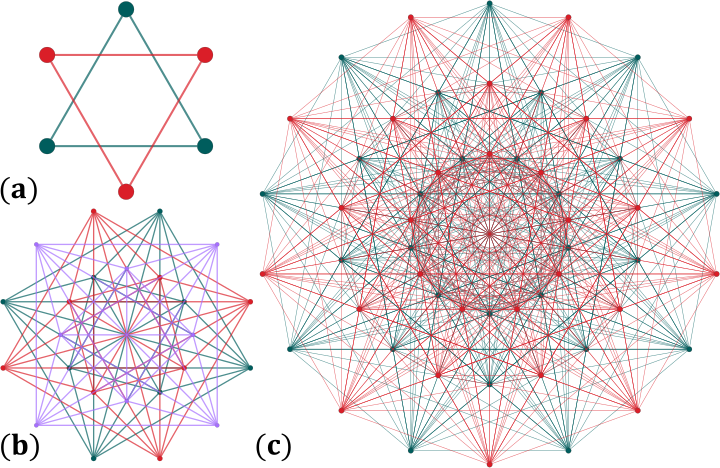
Using the vertices of highly symmetric polytopes in several modes, we found multimode cat codes that outperform single-mode cat codes with a similar kind of overhead. For example, a three-mode code built from the Hessian polytope detects up to eight losses while keeping its points as well separated as a six-component cat code, whereas a single-mode cat code needs at least eighteen components to detect that many. We also showed that combining cat codes with ordinary qubit (CSS) codes yields quantum spherical codes, which points to a new way of protecting against dephasing autonomously.
In follow-up work with Yijia Xu, Alexander Barg and Victor Albert, presented at the APS Global Physics Summit 2026, we construct quantum spherical codes from classical codes and give recipes for their logical gates.
Talks
-
Mar 2026
Quantum spherical codes II
-
Sep 2024
Quantum spherical codes
-
Aug 2024
Quantum spherical codes
Related
Cite
@article{jain2024quantum,
  title   = {Quantum spherical codes},
  author  = {Jain, Shubham P. and Iosue, Joseph T. and Barg, Alexander and Albert, Victor V.},
  journal = {Nature Physics},
  volume  = {20},
  number  = {8},
  pages   = {1300--1305},
  year    = {2024},
  doi     = {10.1038/s41567-024-02496-y}
}