Transversal Clifford and T-gate codes of short length and high distance
IEEE Journal on Selected Areas in Information Theory 6, 127–137 (2025)
In short
We built the smallest known quantum codes, for distances up to 31, in which key logical gates, including the T gate needed for universal computation, can be applied fault-tolerantly one physical qubit at a time.
Why it matters
A quantum computer has to compute on encoded information without letting errors spread. The simplest way to do this is a transversal gate: the same single-qubit operation is applied to every physical qubit at once, so a fault on one qubit cannot spread to its neighbours. No single code can implement a universal gate set this way. Practical schemes therefore pair codes that handle the easy Clifford gates with a separate route to a harder non-Clifford gate such as T. That route is often costly magic-state distillation, or switching to another code in which T is transversal.
Several hardware platforms now support interactions between distant qubits, which makes compact codes realistic. That raises a concrete question: for a given distance, how few qubits do such codes need?
What we did
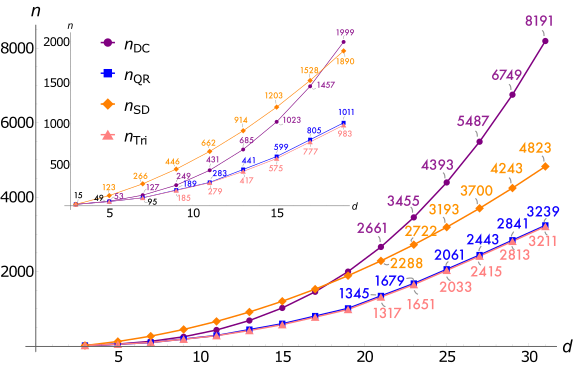
We constructed three families of codes, each encoding one logical qubit, with distances up to 31. Starting from classical quadratic-residue codes, we found the smallest known doubly even codes, which implement the whole Clifford group transversally. Feeding these into a known doubling procedure gave the smallest known weak triply even codes, in which the T gate is transversal with no corrections needed. Relaxing the triply even property, we built triorthogonal codes from the best known classical self-dual codes. These are smaller still, at the cost of a few extra Clifford gates after the transversal T.
At distance 31, for example, our T-gate codes use about 3,200 physical qubits, compared with 8,191 for doubled color codes. The weights of their stabilizer checks also grow only about as fast as the square root of the code length.
Talks
-
Apr 2025
Transversal Clifford and T-gate codes of short length and high distance
-
Feb 2025
High-distance codes with transversal Clifford and T-gates
-
Oct 2024
High-distance codes with transversal Clifford and T-gates
Related
Cite
@article{jain2025transversal,
  title   = {Transversal {Clifford} and {$T$}-gate codes of short length and high distance},
  author  = {Jain, Shubham P. and Albert, Victor V.},
  journal = {IEEE Journal on Selected Areas in Information Theory},
  volume  = {6},
  pages   = {127--137},
  year    = {2025},
  doi     = {10.1109/JSAIT.2025.3570832}
}