Classification of Generalised Triorthogonal Codes through Length 54
arXiv preprint (2026)
In short
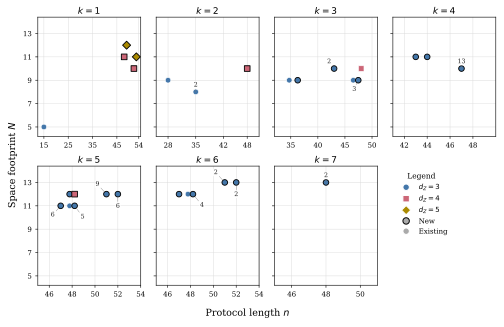
Magic-state distillation is a standard way to supply the non-Clifford resources that a fault-tolerant quantum computer needs. We exhaustively classified the most common family of distillation protocols up to 54 input states and found 74 optimal protocols, 65 of which are new.
Why it matters
Fault-tolerant architectures can usually run Clifford (stabilizer) operations cheaply, but those alone are not enough for universal quantum computation. The missing ingredient is a supply of magic states, which are consumed to apply gates such as T, CS or CCZ. Magic-state distillation turns many noisy T states into fewer, cleaner magic states using only Clifford operations. The most widely used protocols come from generalised triorthogonal codes.
A good protocol has high distance, meaning many input errors are needed to corrupt the output. It also produces as much useful output per input as possible and fits on a small number of qubits. Earlier searches mostly relied on heuristics that do not guarantee optimality. The one complete classification, by Nezami and Haah, covered only protocols with n + k ≤ 38.
What we did
With Adam Wills and Shraddha Singh at IBM Research, we extended the classification to every protocol of length up to 54 with distance at least 3. First, we used a directional-derivative method to extend the Nezami–Haah classification of the underlying unital triorthogonal spaces from length 38 to 54. We then built full protocols by adding logical rows that satisfy the triorthogonality constraints.
We kept only the protocols that no other protocol beats in input count, space footprint and distance for the same output. That leaves 74 optimal protocols, 65 of them new to the literature. Many of them output multi-qubit magic states instead of plain T states, which matters because distilling a state tailored to an algorithm can be cheaper than assembling the same operation from T gates.
Related
Cite
@misc{wills2026classification,
  title         = {Classification of Generalised Triorthogonal Codes through Length 54},
  author        = {Wills, Adam and Jain, Shubham P. and Singh, Shraddha},
  year          = {2026},
  eprint        = {2609.30860},
  archivePrefix = {arXiv},
  primaryClass  = {quant-ph}
}